Irlanda e a sua bebida rei, o whiskey
Visitas 0
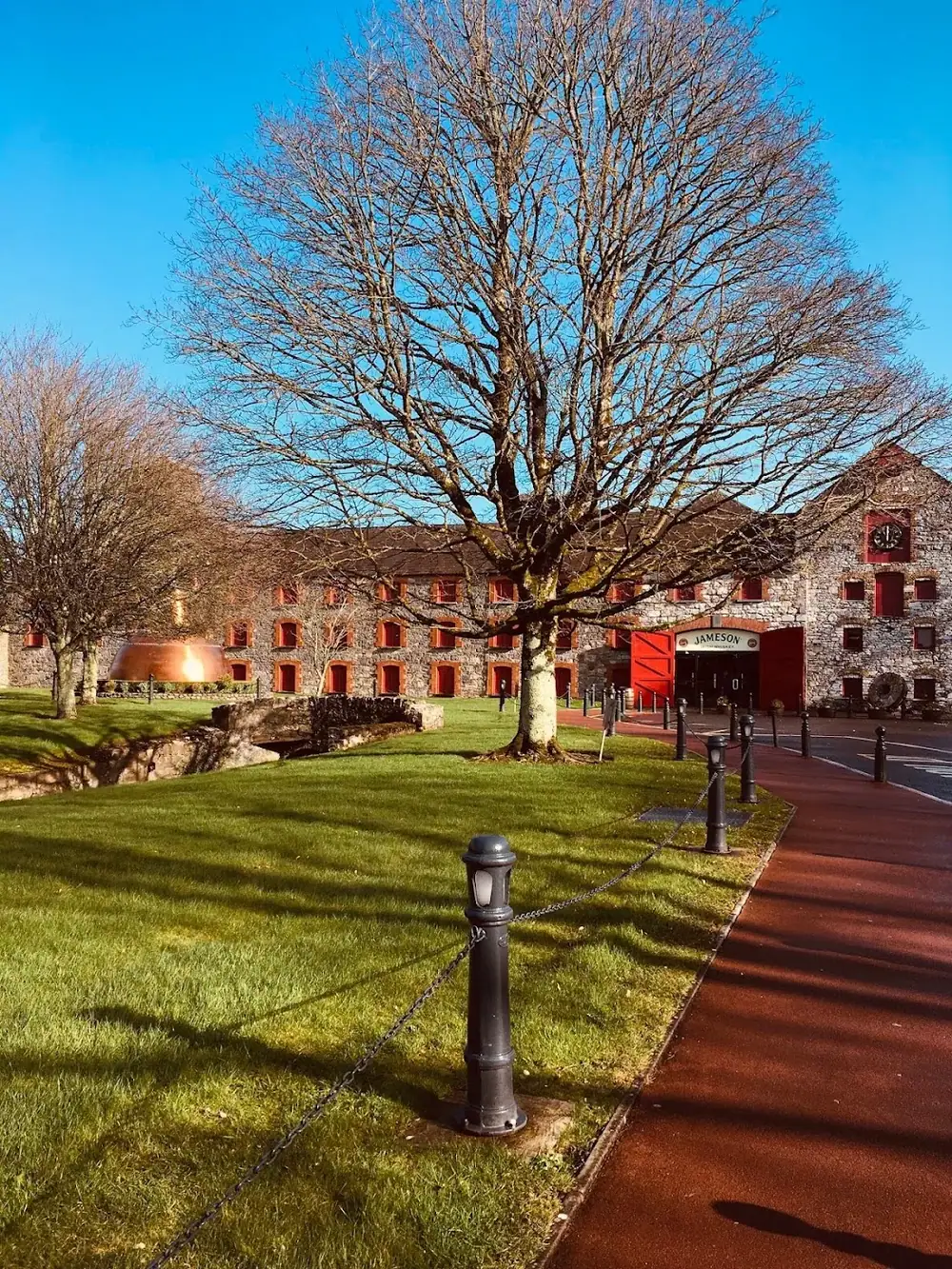
Num dos meus passeios fui à Jameson Distillery , em Midleton, na Irlanda.
Embora apreciasse whiskeys e de alguma forma imaginasse o processo, não o conhecia como hoje.
A destilaria remonta a 1867, quando os irmãos Murphy decidiram mudar os seus negócios e se unir a quatro destilarias, criando a Cork Distilleries Company .
Esta, em 1966, fundiu-se a duas famosas destilarias de Dublin, Powers e Jameson, que pouco depois levaram a produção de whiskeys de Dublin para Midleton, onde permanece nos dias de hoje.
Os ingredientes principais desta bebida são cevada , malte , milho e água .
A cevada entregue exclusivamente pelos agricultores locais é submergida em água, onde fica a germinar durante 4 dias. Antes de ser armazenada, a cevada germinada, chamada de malte, é seca em fornos alimentados a carvão (antracite), um carburante sem aroma ou sabor (um dos pormenores decisivos que o distingue dos whiskeys escoceses e americanos).
O armazenamento é feito no celeiro, o maior edifício do complexo, que, quando repleto, alberga 50 toneladas de grãos. As diversas janelas servem para arejar o espaço devido ao pó que se vai acumulando.
O edifício do moinho, um resquício do primeiro negócio dos irmãos Murphy, foi utilizado até 1975 para moer a cevada e o malte, e os transformar em farinha.
De seguida, dá-se inicio à elaboração do whiskey. Este processo consiste em misturar a cevada e o malte com água quente. Nesta etapa, a maceração , o amido dos cereais é transformado em açúcares fermentáveis. O líquido resultante, o mosto , é depois transferido para cubas.
Nas cubas, dá-se inicio à fermentação , adicionando-se leveduras ao mosto, que, como resultado, produz álcool e dióxido de carbono, num processo que demora três dias. O líquido resultante chama-se " wash " e contém aproximadamente 10% de volume alcoólico.
Por fim, alcança-se a etapa da destilação , que se dá num alambique de cobre . A marca Jameson possui o maior do mundo, com uma notável capacidade de 144 000 litros.
O resultado final das três destilações no alambique contém cerca de 84% de álcool, e apresenta- se como um licor muito puro.
Antigamente, o triplo processo de destilação decorria com o enchimento do primeiro alambique de cobre com o "wash" resultante do processo anteriormente descrito. Depois, acendia-se uma fogueira por baixo para elevar a temperatura. Simplificando, a destilação é o processo em que se separa o álcool da água. O álcool evapora aos 78ºC, enquanto a água evapora aos 100ºC. Logo, os primeiros vapores são álcool. Estes vapores voltam a condensar num nova tina, formando um líquido de teor de álcool superior. O processo repete-se mais duas vezes.
Hoje em dia também se usa a destilação contínua , que consiste numa mistura de malte e milho, que, da mesma forma, dá origem ao "wash", e é chamado whiskey de grão. A diferença está em que em vez de se destilar três vezes em alambique de cobre se faz uma tripla destilação em coluna de destilação contínua. O licor deste whiskey contém aproximadamente 94% de álcool.
Para se fabricarem diferentes qualidades de whiskeys, misturam-se barris de whiskeys de alambique e barris de whiskeys de grão.
Em 2015, foi construída uma micro-destilaria, que possui três alambiques de menor dimensão. O primeiro tem uma capacidade de 2500 litros, para destilar o " wash ". O segundo alberga a segunda destilação, " feints, " e o terceiro produz a destilação final, a " spirit ", e tem uma capacidade de 1500 litros. Estas perdas de volume durante as destilações são as responsáveis pela excelente qualidade e o elevado preço.
Por fim, cheguei à adega .
A adega da Jameson data de 1830 , e, por lei, nenhum whiskey irlandês se poderá chamar tal se não tiver pelo menos um estágio em barricas de Carvalho igual ou superior a três anos. Há dois tipos de barricas. As barricas encomendadas aos EUA, que são de Bourbon e têm uma capacidade de 200 litros, e são de Carvalho Branco ( Quercus Alba ), com a superfície interna carbonizada para acrescentar notas doces de baunilha e caramelo.
As barricas encomendadas em Espanha são de Xerez e têm uma capacidade de 500 litros, a madeira utilizada é Carvalho europeu ( Quercus Roubar ), passada somente pelo lume de forma a tostar e não a carbonizar para acrescentar notas de fruta carnosa, bagas vermelhas, que fornecem tonalidades arruivadas ao whiskey.
No Jameson, o whiskey estagia pelo menos quatro anos e tem uma perda de cerca de 2% do seu volume por ano, uma quantidade generosa no quarto ano (16 litros em 200 litros). A esta perda os irlandeses chamam "a parte dos anjos" , pois é inevitável para aferir a qualidade angelical que desejam e uma das razões de o whiskey ser mais caro com a 'idade em barrica'.
No final da experiência, deram-me a provar três whiskeys: um americano, um escocês e um irlandês.
O rigor e as diversas destilações enriquecem o Whiskey irlandês em aromas e sabores.
Que dia tão cheio e molhado!
Na Irlanda, tudo é chuva, tudo é água. O que me leva a um dos segredos desta bebida — a diluição do whiskey puro com água do rio para se obter o resultado final, um volume de 40%, que é a percentagem universal para um whiskey convencional (e também seria ilegal vender bebidas com 94% de álcool!).
Uma curiosidade é a escrita da palavra.
Na Escócia e no Canadá escreve-se whisky e na Irlanda e nos EUA escreve-se Whiskey. Há outra teoria. Baseia-se no número de destilações da bebida. No whisky ocorrem 2 destilações e no whiskey ocorrem 3. Mas esta teoria exclui os EUA onde a destilação só ocorre uma vez.
O whiskey irlandês é o único que se destila três vezes. Já o whiskey escocês destila-se duas vezes e, o americano, apenas uma.
Até breve,
On one of my outings, I visited the Jameson Distillery in Midleton, Ireland.
Although I enjoyed whiskey and had some idea of the process, I did not know it as I do today.
The distillery dates back to 1867, when the Murphy brothers decided to change their business and join forces with four distilleries, creating the Cork Distilleries Company.
In 1966, this company merged with two famous Dublin distilleries, Powers and Jameson, which shortly afterwards moved whiskey production from Dublin to Midleton, where it remains to this day.
The main ingredients of this drink are barley, malt, corn and water.
The barley, supplied exclusively by local farmers, is submerged in water, where it germinates for 4 days. Before being stored, the germinated barley, known as malt, is dried in anthracite-fired ovens, a fuel without aroma or flavour—one of the decisive details that distinguishes it from Scottish and American whiskeys.
Storage takes place in the granary, the largest building in the complex, which, when full, holds 50 tonnes of grain. The various windows ventilate the space, because dust gradually accumulates there.
The mill building, a remnant of the Murphy brothers’ first business, was used until 1975 to grind the barley and malt and turn them into flour.
Next comes the whiskey-making process. This involves mixing the barley and malt with hot water. At this stage, mashing, the starch in the grains is converted into fermentable sugars. The resulting liquid, the wort, is then transferred to vats.
In the vats, fermentation begins: yeast is added to the wort, producing alcohol and carbon dioxide in a process that takes three days. The resulting liquid is called “wash” and contains approximately 10% alcohol by volume.
Finally, we reach the distillation stage, which takes place in a copper still. Jameson has the largest in the world, with a remarkable capacity of 144 000 litres.
The final result of the three distillations in the still contains around 84% alcohol and presents itself as a very pure spirit.
In the past, the triple distillation process began by filling the first copper still with the “wash” produced in the process described above. A fire was then lit underneath to raise the temperature. Put simply, distillation is the process of separating alcohol from water. Alcohol evaporates at 78ºC, while water evaporates at 100ºC. Therefore, the first vapours are alcohol. These vapours condense again in a new vat, forming a liquid with a higher alcohol content. The process is repeated twice more.
Nowadays, continuous distillation is also used. This consists of a mixture of malt and corn which, in the same way, produces “wash”, and is called grain whiskey. The difference is that, instead of being distilled three times in a copper still, it undergoes triple distillation in a continuous column still. The spirit from this whiskey contains approximately 94% alcohol.
To produce different qualities of whiskeys, casks of pot still whiskeys are blended with casks of grain whiskeys.
In 2015, a micro-distillery was built, with three smaller stills. The first has a capacity of 2500 litres, for distilling the “wash”. The second houses the second distillation, “feints”, and the third produces the final distillation, the “spirit”, and has a capacity of 1500 litres. These losses in volume during distillation are responsible for the excellent quality and high price.
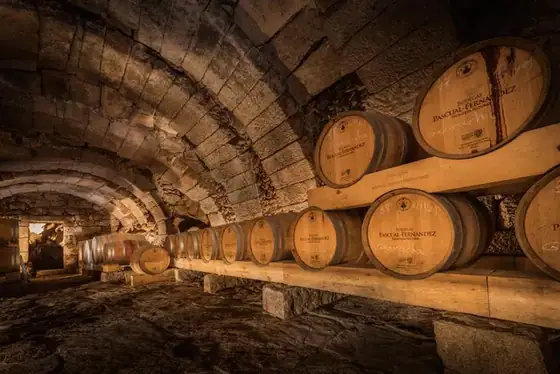
Finally, I arrived at the cellar.
The Jameson cellar dates from 1830 and, by law, no Irish whiskey can be called whiskey unless it has spent at least three years ageing in Oak casks. There are two types of casks. The casks ordered from the USA are Bourbon casks with a capacity of 200 litres, made from White Oak (Quercus Alba), with their inner surface charred to add sweet notes of vanilla and caramel.
The casks ordered from Spain are Sherry casks and have a capacity of 500 litres. The wood used is European Oak (Quercus Roubar), treated only with heat so that it is toasted rather than charred, adding notes of fleshy fruit and red berries, which give the whiskey reddish tones.
At Jameson, the whiskey ages for at least four years and loses around 2% of its volume each year—a generous amount by the fourth year (16 litres in 200 litres). The Irish call this loss “the angels’ share”, because it is unavoidable if they are to achieve the angelic quality they seek, and it is one of the reasons whiskey becomes more expensive with its ‘age in cask’.
At the end of the experience, I was given three whiskeys to taste: an American, a Scottish and an Irish one.
The care and the various distillations enrich Irish Whiskey with aromas and flavours.
What a full and rainy day!
In Ireland, everything is rain, everything is water. Which brings me to one of the secrets of this drink—the dilution of pure whiskey with river water to achieve the final result, an alcohol content of 40%, the universal percentage for a conventional whiskey (and it would also be illegal to sell drinks with 94% alcohol!).
One curiosity is the spelling of the word.
In Scotland and Canada, it is written whisky, while in Ireland and the USA it is written Whiskey. There is another theory. It is based on the number of distillations the drink undergoes. Whisky is distilled twice, while whiskey is distilled three times. But this theory excludes the USA, where distillation only takes place once.
Irish whiskey is the only one distilled three times. Scottish whiskey is distilled twice, and American whiskey only once.
Until next time,
Menina do Livrinho . wine
Menina do Livrinho.Wine
- Vinhos do Mundo
- Irlanda
- Jameson
- Midleton
- feints
- spirit
- wash
- whiskey
Galeria
Comentários (0)
Este artigo ainda não tem comentários.
Deixar um comentário
Comentário enviado
Vai ser publicado depois de ser aprovado. Obrigada pela partilha!
O comentário não foi enviado
Houve um problema a falar com o servidor. Tenta outra vez daqui a pouco — o que escreveste continua aí.